
Forum
Market
- Kongsberg Sabelbajonett M/1851 nr. 650
- Duckfoot Flintlås
- James Reid pepperbox
- Jarmann karabin
- Werndl prosjekt / delebørse
- Blunderbuss - Muskedunder
- Uberti colt army
On this day
6 August 1777
The Norwegians could shoot into the side of the column, which fell apart. After regrouping, the Swedish forces tried another tactic using skirmish lines, where shooters in scattered order attempted to maintain continuous fire against the defenders. ... Read more ...
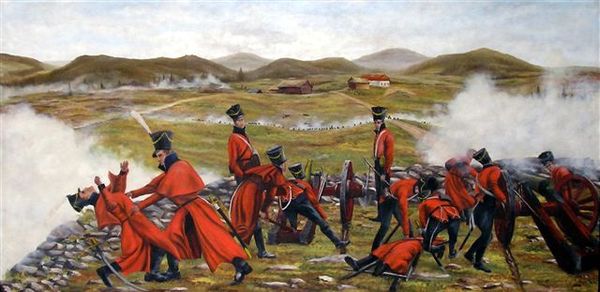
The Skirmish at Langnes Entrenchment
The Norwegians could shoot into the side of the column, which fell apart. After regrouping, the Swedish forces tried another tactic using skirmish lines, where shooters in scattered order attempted to maintain continuous fire against the defenders.
The Swedes had better powder and better weapons. The attacks by the skirmish lines had an effect on the vulnerable battery position located high above the breastwork. Several, among them Lieutenant Hauch, fell under the Swedish fire, which was reinforced by sharpshooters who eventually found good positions in trees from which they could shoot into the entrenchment from above. Hegermann directed the cannons at the sharpshooters, who retreated after several well-placed shots. Through effective use of artillery fire, Hegermann held his ground against the Swedes, who gave up after the third attack. Nevertheless, the firing from the Swedish hunters had shown that the cannon position on the small hill could not be held in the long run, and it was clear that the entrenchment would eventually have to be abandoned.
Featured article

During the heyday of the percussion revolver soldiers almost exclusively loaded their revolvers with paper cartridges. This article gives you a short historical background of the use of paper cartridges, shows you how to make your own and finally how to shoot them.
Making paper cartridges
Ultrasonic cleaning: The best there is?
 About
About Les artikkel på norsk
Regardless of how boring and messy it may be, cleaning spent black powder brass is a necessary evil. Usually it suffices to rinse the cases in hot soapy water to get rid of the worst fouling, but in the last couple of years ultrasonic cleaners have become increasingly popular. But do you really need such a high-tech device to clean dirty brass?
Drag the slider to see a before and after photo. Read more below about what it takes to achieve this result.


Ultrasonic cleaner from Biltema.

The .45 Colt brass before cleaning.

Result after 8 minutes.

Result after 16 minutes.

Result after 24 minutes.

From left to right: The starting point and brass cleaned in 8, 16 and 24 minutes respectively.

The primer pockets.
I got my cleaner from Biltema for 949 Norwegian Crowns ($155). It holds 2.5 litres of water and has 70W heating effect. It is actually almost identical to Lyman's Turbo Sonic 2500 Ultrasonic Case Cleaner. It comes from the same producer and is identical except that the Lyman version comes with a higher price tag. ($290 from Midway Norway, and yes, prices are generally higher in these parts of the woods). Part of what you pay extra for is the Lyman logo and 160W heating effect. However, if you need more heating effect you can compensate by using pre-heated water.
The tank is large enough to hold the brass from an average trip to the rifle range. According to Lyman the capacity is 900 9mm Luger cases. The cleaner can be run in five different cycles: 90, 180, 280, 380 and 480 seconds – or from 1.5 to 8 minutes.
Cleaning solutions
Hot water alone doesn't clean the brass. In the last couple of months I have tested two different cleaning solution recipes. Both use dishwasher detergent as a basis to dissolve grease and fouling. While this cleans the brass, it does not make them shiny. Many recommend a table spoon or two of citric acid along with the hot water and detergent, but what has worked best for me is a solution containing 4 parts water, 1 part vinegar, 1 table spoon salt and 1 table spoon dishwasher liquid.
Important:
Vinegar-based cleaning solutions must never be used to cleaned blued firearms parts as vinegar efficiently removes blueing!
Ultrasonic cleaning solutions purpose made for cleaning brass are commercially available from Lyman and other suppliers of reloading equipment, but from what I have heard they work rather poorly compared to both the vinegar and citric acid solution.
After cleaning the cases must be rinsed in hot water to remove any traces of soap or cleaning solution, after which they are set aside to dry.
Practical use of the ultrasonic cleaner
The cleaner performed well on newly fired brass, especially with the vinegar solution. I tested a batch of .45–70 calibre brass that I had previously cleaned in hot water and soap, and they absolutely became noticeably cleaner after 8 minutes in the ultrasonic bath. Whether it is necessary to vigorously clean the brass this way for each reloading is another question.
However, if you have batches of really dirty brass an ultrasonic cleaner is just what you need. When I came across a batch of dirty .45 Colt brass that had been left in a bag for about four or five years I decided to put the ultrasonic cleaner through its paces. Even though they were stored dry the brass had become dark from the black powder fouling and some cases were lightly covered in verdigris.
While removing the primers I let the vinegar solution heat in the cleaner until it reached about 65 degrees Celsius, after which the cases was put into the tank and the machine turned on. After 8 minutes the brass showed clear signs of improvement. After 16 minutes the results was acceptable, but after another 8 more minutes they were perfect. 24 minutes was enough to completely clean the cases inside and out.
Note that cases cleaned in ultrasonic cleaners always have a dull or matte finish. If you want shiny brass you must run them in a case tumbler afterwards.
See a video of the cleaning process:
Are ultrasonic cleaners really necessary?
Do black powder shooters really need these high-tech cleaners? If you're a recreational shooter I'd say the answer is no. Even with an ultrasonic cleaner it is still quite a lot work involved, such as preparing the cleaning solution, drying cases and so on. Usually it takes from 8 to 16 minutes to clean a batch of once-fired black powder brass. For the average shooter it is good enough to rinse the brass thoroughly in hot, soapy water. And if you already have a case tumbler I'd say you don't need an ultrasonic cleaner.
A drawback with the Biltema version is that it stops if it's overheated. This usually happens it runs continuously for more than 20 minutes. The only remedy is to let it cool for a while.
Cost is also something to consider. Vinegar, citric acid and washing-up liquid all cost money in the long run.
That being said, an ultrasonic cleaner have many other areas of application and can be used for cleaning gun parts, cylinders, magazines, sizing and reloading dies, as well as bullet moulds and motor parts.
Looking for other bras cleaning recipies? Here's a site with Four homemade brass cleaner and polish recipes.