
Forum
Market
- Marinepistol 1843
- Remington 1863 Pocket replika
- Rullekrymper til hagle kal 12
- Løpsemne cal 50
- Kuletang 45lC
- 8mm Kongsberg Rolling Block
- Hylser til 12,17x44r
On this day
23 October 1157
The battle of Grathe Heath was fought between the Danish armies of Valdemar the Great and his rival for the Danish throne, Svein Grath. Svein's army was defeated by Valdemar forces, but Svein even managed to escape. Shortly after the battle,... Read more ...
The Danish civil wars came to an end
The battle of Grathe Heath was fought between the Danish armies of Valdemar the Great and his rival for the Danish throne, Svein Grath.
Svein's army was defeated by Valdemar forces, but Svein even managed to escape. Shortly after the battle, however, he was killed by a farmer while he hid in Grathemose. After this, Valdemar the Great became sole king of Denmark.
The battle also marked the end of the civil wars between Svein Grath, Knut 5. Magnusson and Valdemar the Great, all of whom fought for the Danish throne.
Valdemar stabilization of Denmark began immediately after the battle. He acted as a conciliatory victor, and forgave most of their previous opponents. Only Knut Magnusson murderers were executed, while a few of Svein's advisors were ostracized.
Archeologists have found a lot of weapons om the battle site, especially axes.

Featured article

From time to time you stumble across things you can\'t manage without. One of my things is Jeff Tanners powder dispenser. It\'s simple, cheap, and best of all: it\'s incredibly time-saving. I\'ve used mine for a couple of years now, and my old Lyman No. 55 is used less and less.
Jeff Tanner\'s powder dispenser
Exploded View of a Flintlock Musket
 About
About Les artikkel på norsk
The smoothbore military flintlock musket was the standard infantry firearm for hundreds of years before the percussion muskets and breech-loading rifles took over from the mid-1850s. The Norwegian Army received muskets from Denmark during the union years, but after the union with Denmark fell apart and another union was established with Sweden in 1814, the Norwegians started their own firearms production at Kongsberg. A typical Norwegian-Danish musket looked like this:
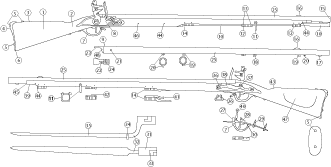
- Butt
- Wrist
- Comb
- Heel
- Butt plate with screws
- Toe
- Trigger guard
- Flint lock
- Barrel breech
- Ramrod
- Front sling swivel with screw
- Thimble
- Thimble pins
- Entry thimble
- Muzzle
- Front sight
- Bayonet lug
- Ear for the sling swivel screw
- Double ear — pin ear — for securing the thimbles
- Single ear- pin ear - for securing the barrel to the stock
- Flash hole
- Rear sight notch
- Tang
- Breech plug
- Barrel
- Rear sling swivel with screw
- Ramrod stopper
- Trigger
- Trigger guard screws
- Trigger assembly
- Bayonet socket
- Elbow
- Bayonet lug slot
- Shoulder
- Triangular blade
- Front side plate screw
- Rear side plate screw
- Side plate
- Muzzle cap
- Tang screw
- Brake spring for the ramrod
- Back of the thimble
- Butt nose
- Barrel pin
- Butt nose
- Fore-stock
- Cheek piece
- Breech plug
Find out more!
You can learn more about the history and practical use of smooth-bore flintlock and percussion muskets in the brand new book From Musket to Metallic Cartridge: A Practical History of Black Powder Firearms.